Episode Transcript
[00:00:00] Speaker A: Wow, Nathan. I'm crying, y'.
[00:00:02] Speaker B: All.
[00:00:02] Speaker A: I you like you revisiting being cracked open is cracking me open a little bit. Two things that I haven't really said out loud in a long time.
I love across the floor. I love that there. And I'm crying about across the floor.
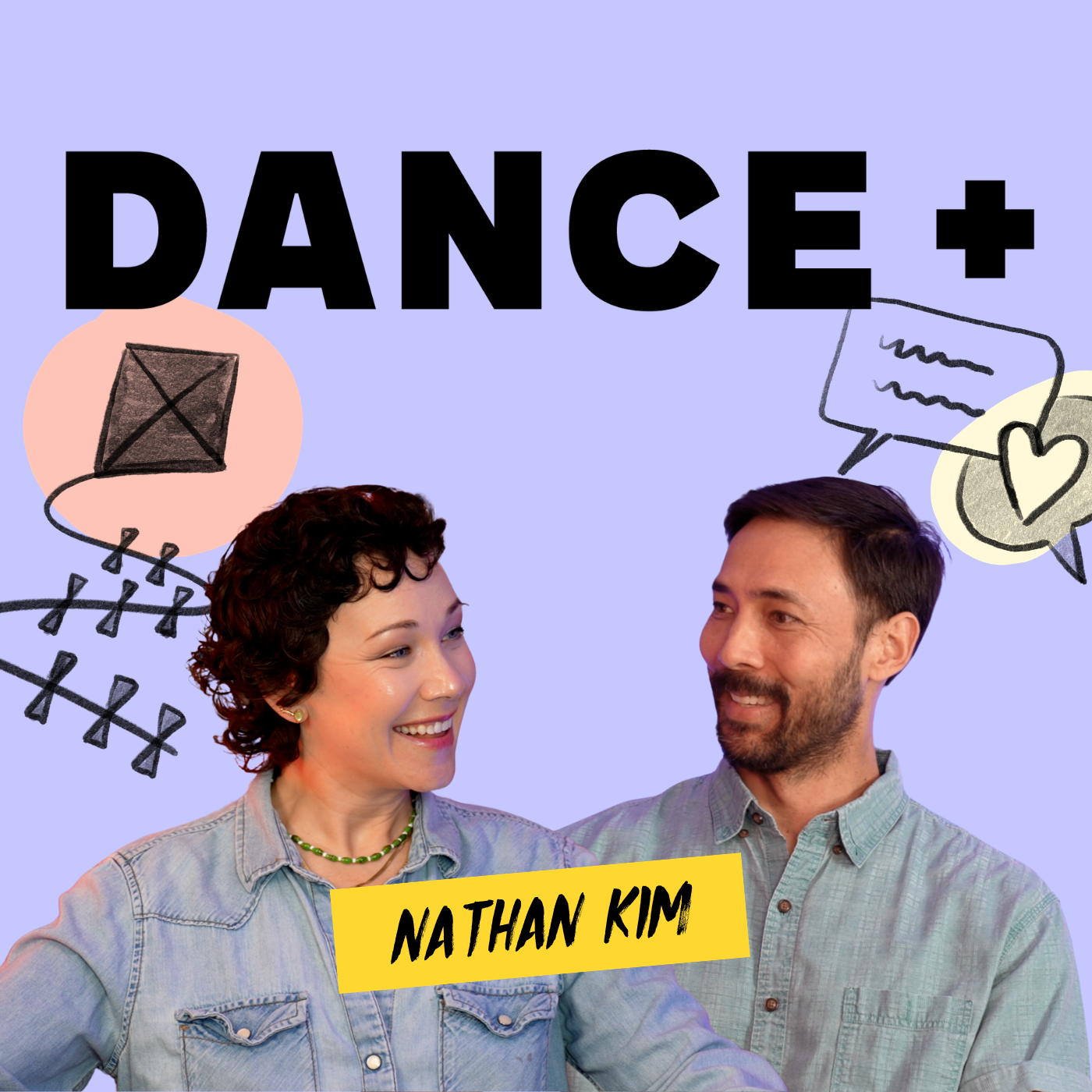
Hello. Hello. My friend Dana. I'm Dana. This is dance. Welcome. I'm stoked for this episode because if you've been listening for a while, you know that it's not so common that I have people that I don't already know very well on the podcast. And I have known of our guest today, Nathan Kim, for a very long time, but we have orbited. We have never crossed paths like on a gig together. Haven't shared dance space very often, but. But I am a huge admirer of this person's work and of their way. And I'm so excited to share this conversation with Nathan. But first, we do wins on the podcast and today I am celebrating new freaking dance plus merch. Are you ready for it? Are you ready? Can we zoom in on this? You know what? We're gonna insert images here. That's what we're gonna do. We have what I'm calling the iconic mug that has all our iconography on it and the classic dance words that move me logo. We have a pug mug. We have a mug mug. And we have T shirts and sweatshirts coming very, very soon. Also, so many stickers. All the stickers, they won't be available yet by the time this episode comes out, but I will very, very shortly be including the link to our online store. If you'd like to support this podcast by representing us out there in the world and by putting super sweet stickers on all your.
That's what's going well.
[00:01:53] Speaker B: What about you?
[00:02:09] Speaker A: Congratulations. I'm so glad you're winning. Let's get into this conversation with Nathan Kim.
You probably have seen his work before. If you've seen Charli XCX, if you have watched dance videos on YouTube, and certainly if you have watched A Brand New Day. We're going all the way in on process for that film and the important points, the important moments and decisions, the instincts even, that led Nathan from being a non dancer in Maui to choreographing one of the biggest films of this year that I cannot stop talking about and thinking about. And good job, Nathan.
Here he is. Nathan Kim.
Nathan Kim, welcome to the podcast.
[00:03:03] Speaker B: Thanks for having me.
[00:03:04] Speaker A: I'm thrilled. I saw Brand New Day, Brand New few days ago and I have a Lot of questions. But outside of that film, I. I've been an admirer of yours at a distance. I don't think we've ever professionally crossed paths other than rubbing elbows in studio spaces and whatnot. So I'm thrilled to get to know you. Thank you again for coming.
[00:03:23] Speaker B: Thank you for having me.
[00:03:25] Speaker A: Okay, first item on our agenda. Some people cringe at this. I am so curious to hear how you would introduce yourself. So instead of me introducing you to listeners, I will let you tell them anything you want them to know about you.
Go.
[00:03:40] Speaker B: I've sort of been grappling with this question for a while in my creative professional career, like, just trying to understand exactly who I am and what my role is, because it's. It's a place that kind of spans a lot of different positions on different projects where at times I'm, you know, for a lot of my career, I was a dancer, and then it sort of turned into a teacher. I would sub for Ryan Heffington a lot and kind of like, do. Yeah, Sweat spot, kind of like these all levels classes.
And then it sort of started to open up into being a filmmaker where I'd shoot a lot of these, like, independent films.
And then it sort of turned into choreography opportunities and choreographing, and then it's turned into sometimes directing and then creative directing.
So I think what I found for myself is the main through line is that most of the things I do connect to movement in some way and the experience of movement in different visual mediums.
So I like to think of myself, I guess, as just like a movement artist and finding ways to make movement read in impactful and emotional and exciting ways.
[00:04:55] Speaker A: If that was your workshopping this, then I think you can move on to the production phase. That was a beautiful introduction. And yes, and I think maybe that's one of the things that draws me to you and your work is that you are a multi hyphenate. I love a multi type. I love many hats and I love people who wear them many and many at a time sometimes.
Obviously, like the podcast is one of the hats that I wear. The production of this thing is even different than being inside and being a host of this thing. So, yeah, I have so much appreciation for a multi pronged approach, but the thread, the through line that weaves it all together is movement. And I think you're so good at it. And I'm so excited to talk about how good you are at stuff which might be uncomfortable for you, but it's another thing that I Do here at Words that Move Me. So get ready to receive a lot of flowers.
But first, I'm curious about your. Because I first came to know you during the Sweat Spot days when you were teaching there and subbing for Ryan, like you mentioned. But I'm curious about how you were introduced to dance, period. Like, what was your first. What was the entry point to dance for you?
[00:06:01] Speaker B: Well, I feel like I had a bit of a different journey than most of the dancers that I know in the industry.
I kind of grew up. Well, I grew up in Maui and I was sort of the kid that didn't have access to, you know, dance classes totally.
But I definitely loved to dance. But usually it was in private, just kind of like in the living room with, like, my parents CDs and just kind of, like, thrashing around in, like, really kind of, like, wild, expressive ways.
[00:06:33] Speaker A: Yeah.
[00:06:34] Speaker B: And I didn't really know what it was. Sometimes it was just me, like, running around or flailing or, like, rolling over the couch. But I like to, like, feel energy coming out of my body with music.
And I think that was really, like, the core of, like, my love for movement was just sort of like that innocent connection to, like, expression of the body.
[00:06:52] Speaker A: Yeah.
[00:06:53] Speaker B: But like I said, I didn't really have access to any sort of dance classes.
And it wasn't until I was in college, actually, at ucla. I left. I left Maui and I was a pre med student.
[00:07:06] Speaker A: Wow.
[00:07:06] Speaker B: I'm doing a lot of, like, math and science, and that was kind of like my specialty was sort of, like, mathematical things as well as I really loved music too. I was a musician and I was a. So I was a percussionist. So I loved, like, rhythms.
[00:07:19] Speaker A: Yep, yep, yep.
[00:07:20] Speaker B: Yes. You know that brain. Right. Just like, really kind of like clear, mathematical.
[00:07:24] Speaker A: Yep.
[00:07:24] Speaker B: Um, so those were the two things that I really understood and loved was, like, math and music.
But I at some point fell into trying out dance while I was at college.
One of the things I tried was swing dance.
[00:07:39] Speaker A: Ooh, that'll get you.
That'll get you.
[00:07:44] Speaker B: It just seemed, like, so, like, fun and, like, joyful. And I loved, like, the connection aspect, how you're with another person.
[00:07:50] Speaker A: Oh, the physical.
[00:07:51] Speaker B: Yeah, yeah. Just kind of like the playful sort of creating as you go sort of vibe and finding, like, symbiosis with another person in real time.
[00:08:01] Speaker A: Yeah.
[00:08:02] Speaker B: So that was some of, like, the first, like, more like structured dance that I experienced. And then it wasn't until my last year of college that I had some room in my schedule and. And I Thought I wanted to maybe do a Afro Brazilian drumming class.
[00:08:19] Speaker A: Yes.
[00:08:21] Speaker B: Because I love just like the rhythms of the drums and I thought it would be cool to try something different.
But that class was full. So next on the schedule was Afro Brazilian dance.
[00:08:32] Speaker A: Yep.
[00:08:32] Speaker B: And I was like, oh, I do kind of love dancing. And that would be really out of my comfort zone.
[00:08:38] Speaker A: I'll be around the percussionist. I'll be in the rhythm.
[00:08:41] Speaker B: Yeah.
So I was like, I don't know, let me just give it a shot.
So I enrolled in this Afro Brazilian dance class at ucla my last quarter there. And something inside of me, like, you know, we kind of went through the full warmup and I was like, I kind of liked all the physical aspects of it. Very athletic and expressive. And then we have to do this movement going across the floor. And this was kind of like the first time that I had ever done like an across the floor situation.
[00:09:09] Speaker A: Like a repeating pattern. Like a sequence of movements that repeats and travels in a direction.
[00:09:13] Speaker B: Yes, exactly. So it was like a pretty simple movement. It was sort of like this sort of like, kind of like chug and like quickly like traveling across the floor.
[00:09:21] Speaker A: Yeah.
[00:09:22] Speaker B: And you know, it's just like one. I mean, it wasn't one at a time, but you know, everyone's going kind of sequentially.
[00:09:27] Speaker A: Yeah.
[00:09:27] Speaker B: And it was just sort of like this do or die moment where up until that point I think I had felt so self conscious about my movement. Because in any sort of like social dance setting, like, like school dances, I never felt like I could get up there and dance because what I saw in front of me, I just didn't, I didn't recognize it as dance. Like, that wasn't how I moved. It was so like kind of like controlled and cool and I was just a little bit like wild and expressive and flaily. And I was like, I was like, oh, I don't, I don't know how to do that.
And somehow in this moment, in this Afro Brazilian dance class, there was like this big moment that. This big movement that I was being asked to do. And it was kind of just do or die. Like it's like one of those, those physical shapes that you can't do like a small version of it.
[00:10:17] Speaker A: Oh, not marketing, you know what I mean? Exactly.
[00:10:19] Speaker B: You can't market.
[00:10:20] Speaker A: Yeah, yeah. You're full, full pedal to the metal.
[00:10:22] Speaker B: It's either like commit or don't do it at all. And I'll just like, just fully committed. And I just like went for it. And something inside of me Just broke open in that moment. And I've just felt like. I never felt like, more free and more like, alive and expressive the way I felt like in my living room as a kid. And. And I just kind of fell in love with it. And the rest of the course, I just kind of carried on with that freedom.
[00:10:47] Speaker A: Committed to the guess.
[00:10:48] Speaker B: Just committed all in. Just like, I don't know exactly what I'm doing. I don't know. I don't know. You know, my body isn't familiar with this vocabulary, but I can go for it and I can sort of just express myself in this big way because there was a structure for it now for me to express myself in this kind of, like, physical space.
[00:11:05] Speaker A: Wow, Nathan. I'm crying, y'.
[00:11:07] Speaker B: All.
[00:11:07] Speaker A: I. You like you revisiting being cracked open is cracking me open a little bit. Two things that you. That I love that I haven't really said out loud in a long time.
I love across the floor. I love that there. And I'm crying about across the floor.
I love that there is a finality to it and that that finality is just two eight counts away. Maybe five seconds it might take me to get from one side of the floor. So it's so fast. Easy to go all in for something that short. Like, you can do anything for an eight count. You could do anything for three. 30. 30, probably.
And I. I feel like I also have had hugely pivotal, no pun intended, moments with an across the floor. With across the floor training. Because it seems so, like, okay, I can do anything for one length of this room. And yeah, when you start thinking that way, then you try. And when you try, you unlock new levels of opportunity, willingness, and yeah, the physicality, the actual technical things that you're practicing across the floor. That's it. Totally that and swing. I'm such a huge fan. Social dance in general, I don't practice enough because I think I have a very opposite experience of dance from you, which was. It was choreography from the beginning.
So wiggling social dance into my life came with a lot of humbling myself down to being a beginner at something that in my mind I should be really good at. And social dance is like hugely that for me. But the only thing I love more than dance is people.
And with social dance, you have two of my favorite things in the world happening at once. So totally I don't do it more, but I hearing your stories inspiring me. Thank you.
[00:12:58] Speaker B: Yeah.
[00:12:59] Speaker A: Okay, cool. So that gets you to la, but you were still pre med at this moment. How did the decision to change career path happen?
[00:13:09] Speaker B: That's quite a pivot. While I was at. In college, I don't want to go too much down this road, but I ended up, like, realizing that, you know, I. I worked with a cadaver once, and I saw the inside of a human body and I just about like, fainted. And I was like, I cannot. I can't look at blood. I don't want to deal with any of this. And I was like, what else, what else would be interesting? So I just started. Started taking all sorts of classes and
[00:13:31] Speaker A: I ended up getting living bodies enclosed together with movement.
[00:13:36] Speaker B: Movement healthy and music vibrant.
Yeah.
[00:13:41] Speaker A: Brilliant. Okay, that makes total sense. And is that.
[00:13:44] Speaker B: Go ahead. So I ended up getting a degree in mass communication, but sort of found this, like, random love for dance in the process.
[00:13:51] Speaker A: Yeah.
[00:13:52] Speaker B: And when I finished with school, I kind of fell into this place where I wasn't exactly sure what I wanted to do with my life, but I knew I loved dance, so I kind of continued with that and started just doing some classes on the side at smc, continuing with Santa Monica College.
[00:14:11] Speaker A: I love an acronym, but the school system has lots of.
[00:14:14] Speaker B: What are you talking about?
So I started doing more Afro Brazilian classes, but I also tried a ballet class. And this, this teacher, Charlotte Richards, just kind of like took me under her wing and was like, you need to be a dancer. Let me help you. So she just kind of. She started making me take her class at the studio and other studios. And I was just doing ballet twice. Twice a day. Basically, like six, seven days a week.
[00:14:41] Speaker A: Wow.
[00:14:41] Speaker B: And she was like, you have what it takes.
Let's, let's. Let's have your body figure out, like, techniques so that you can actually have like a foundation.
[00:14:50] Speaker A: This is. This person's name is Charlotte.
[00:14:52] Speaker B: Charlotte Richards.
[00:14:53] Speaker A: Work.
[00:14:54] Speaker B: Yeah.
[00:14:54] Speaker A: Thank you, Charlotte Richards. You're a gift for bringing us this gift. Okay. Phenomenal. And during that two a day period, was your relationship still love? Was there ever love, hate relationship? Because I mean, nothing like ballet class will make me hating things.
[00:15:11] Speaker B: Yeah. Yeah.
Well, it was a bit of a love hate.
I love the discipline of it. And I loved kind of being able to explore my body.
[00:15:20] Speaker A: Yeah.
[00:15:20] Speaker B: And like understand really specifically what I was trying to attain with. With every single, like square centimeter of every limb and angle.
[00:15:28] Speaker A: And there is math. There's a lot of math there.
[00:15:31] Speaker B: Yeah. Yeah. But while I was doing that, I also decided I wanted to try some other classes. So I. I tried some jazz classes and I kind of fell into.
I noticed at one of the studios I was taking class at, which was called Zeal in Culver City.
Ryan Heffington was teaching this contemporary class.
[00:15:48] Speaker A: Yeah.
[00:15:49] Speaker B: And I was like, that looks. I have no idea what is going on, but I want to try it.
[00:15:53] Speaker A: I want in.
[00:15:53] Speaker B: I want to try it.
[00:15:54] Speaker A: One in there.
[00:15:55] Speaker B: And it was just. It was so, like, you know, obviously we know Ryan Huffington in the dance world, and just like, the level of, like, abstract artistry and the. And the places that he was going to with his movement and his shapes and his intention, all the. All the foundation of ballet was so valuable in helping me to understand what was being asked of me at times. But, like, Ryan sort of really took me under his wing and kind of became a huge mentor to me. And he sort of, like, trained me and ushered me into the commercial world. Yeah. Just kind of like, throwing me into, like, random, like, little shows. He was producing gigs here and there. And then, you know, I got. I just kind of, like, fell into an agency. Like, some of the. Some of the people involved with one of the shows were agents at a place, ddo, back in the day.
[00:16:50] Speaker A: Oh, yeah.
[00:16:51] Speaker B: And they're like, do you want to. Do you want to audition for stuff? I was like, what does that mean?
[00:16:56] Speaker A: Right.
[00:16:56] Speaker B: Yeah, so. So. So I just kind of, like, fell into, like, auditioning for stuff. And I was like, you know, at first, I had really no clue what I was doing, but I just sort of got thrown into it and was just following, like, whatever doors were opening in front of me.
[00:17:10] Speaker A: Cool.
[00:17:11] Speaker B: Yeah.
[00:17:12] Speaker A: I'm so moved. I love my job as a podcast host. This is a very cool story. Wow, Nathan. I'm geeking out. The doors are opening, you're getting in, you're starting to work, you're learning all the things. And then comes.
I mean, we're really distilling the timeline here.
[00:17:29] Speaker B: Totally.
[00:17:30] Speaker A: But then comes the desire to be choreographing. Or was that also a door that opened and you just were like, sure, we'll try that one.
[00:17:37] Speaker B: That was really by accident. Well, when Ryan first started teaching his Sweaty Sundays classes at the Sweat Spot, it kind of blew my mind. Like, I thought it was so genius because he was offering an opportunity for adults and non professionals to connect with their bodies in an expressive way and to move and to dance, to, like, really cool music in an artful way. And I was like, this is sort of like, this is. This is like, how I found dance was like, as an adult. Really? A young adult.
[00:18:06] Speaker A: Yeah.
[00:18:07] Speaker B: And just. And just behind this idea that all humans have the ability to express themselves physically. We all have bodies. We can all be dancers. You know, you don't have to be a professional, technically trained dancer, but you can still express yourself and learn choreography, too.
[00:18:22] Speaker A: Yeah, yeah, yeah.
[00:18:23] Speaker B: So.
[00:18:23] Speaker A: So dance for all, man. I. So you were like, okay, that is a North Star. I can pursue and get behind.
[00:18:29] Speaker B: I. I was. I loved his classes so much and started teaching at his studio occasionally and then started subbing for him whenever he was out of town. And at the time, you know, he was starting to, like, gig it with, like, Sia and do all these kind of, like, big projects and was, like, out of town all the time. So I would be kind of covering his, like, Sweaty Sundays classes, which were just like, packed with, like, people.
[00:18:50] Speaker A: Yeah.
[00:18:51] Speaker B: And kind of being thrown to the deep end in terms of, like, finding my movement, really. And having to choreograph, like, dances for all these people. And, like, you know, it's a very specific space to choreograph for because it needs to be accessible. Exactly. Like, movement vocabulary that every. Anyone can do, but still, like, a level of, like, artfulness and interesting and.
And able to be, like, you know, bring your soul alive when you move.
[00:19:17] Speaker A: I am just unlocking in my mind right now that Sweaty Sundays is the counterpoint.
I want to say antithesis, but protagonist to the antithesis that is TikTok dance. Like, both of them are dance for all.
But one of them feels like.
I'm gonna say. I'm gonna say this. These two words. One of them feels like fast food, and one of them feels like a culinary experience that you will remember the rest of your life, even if you don't remember the combo for your whole life. Like, the sweaty Sunday invite. And I'm not saying one is better or worse, because God knows I will eat Burger King. I have. There's one across the street. And, like, once a month, I look and I'm like, sure, that's. That's what's happening right now. So I'm not saying.
[00:20:04] Speaker B: I mean, I love Taco Bell. I'm not going to lie to you. Although we're taking a break now.
[00:20:08] Speaker A: Okay.
[00:20:09] Speaker B: You want to.
[00:20:09] Speaker A: You want to. You and Riley can talk about Taco Bell in a second.
Man. Cheesy Gordita Crunch. That's so real.
Grade B, but edible baby.
That is such a fine line and such a difficult thing to craft. Something that looks so easy and something that is so accessible. It's not easy to make something like that. Okay. So you got to flex that muscle and get really Good at that.
[00:20:31] Speaker B: Yeah. So just kind of like, started. Started figuring out how to choreograph material, like, week after week, find music, find ways to connect with the musicality of it and. And also how to teach people that were at a lot of different levels in their. In their kind of movement journey.
So. Oh, and then we'd also have these recitals. That's a sweat spot would put on. And it sort of became, like, a bit of, like, a thing for me to choreographed with just, like, tons of dancers, like, so many bodies. Yeah. I love to just kind of, like, pull in as many people from the community that were interested in being a part of a number and figuring out a way to make, like, put them all together and make something that was just going to be, like, fun and engaging and allow them to all just sort of express this, like, feeling of joy that they found through their movement. Great.
[00:21:22] Speaker A: Meanwhile, you're getting to practice composition, leadership, the. The art of choreography.
[00:21:29] Speaker B: Exactly.
[00:21:30] Speaker A: Wow.
[00:21:30] Speaker B: And formations, how to work with so many bodies, how to move them around on stage in. In, like, patterns and shapes that made sense.
So, you know, it's like, it was just kind of, like, strange how, like, I was just kind of, like, following just this path that. That felt, like, interesting and, like, was in front of me, but it was kind of, like, training me for things that I had no idea that were to come eventually.
[00:21:51] Speaker A: Right. Like, for example, you have. Your resume is illustrious, and I. I'm probably pointing towards the pieces that a lot of people point towards when they think of you or talk to you. So I don't want to be so obvious, but I.
I would give you credit for being the performance that blew up charli xCX. Like, I think that was a pivotal moment for her, and I know you were behind it, and I think those skills that you got to refine in the sweat spot days, which is like dance to dance to reveal untapped emotion.
Making great use of bodies in space because there weren't many. How many dancers were there for parts?
[00:22:34] Speaker B: Well, for most of the tour, it was just two dancers.
[00:22:36] Speaker A: Okay. Right.
[00:22:37] Speaker B: And then for part, like, Coachella, in the end, it was like, four guys.
[00:22:40] Speaker A: Okay. I think you. You made so much bang for the buck with those performances, and I just think she owes her career to you, but that's just me. And who am I? I'm a lady with a dance career and a podcast.
What did you learn from that in particular? From that?
[00:22:58] Speaker B: Yeah. Well, was that your first time working
[00:23:01] Speaker A: with big pop type?
[00:23:02] Speaker B: I mean, honestly, that was like, One of my really just kind of first really big choreography jobs that I got. And it was kind of through my teaching because her creative director, Imogene, would take my class all the time at the Sweat Spot. I had no idea that she was a creative director, but we were just kind of friends and I really liked her. And then when Charlie was thinking about putting together this Crash album and all the visuals for it, she really wanted to hone in on like a dance based concept. Like something a bit like campy 80s, 90s, but like a sort of like modern take on it. And Imogene asked me if I would work with Charlie and help her to kind of like find her movement nice and, you know, just kind of see where it went from there.
[00:23:47] Speaker A: So it started in kind of a
[00:23:48] Speaker B: coaching teaching space, just kind of like exploring. So we would get into the studio twice a week, usually for a few hours in the mornings, and just kind of, you know, like play around with movement. See what. See what worked on her body, see, see how she naturally liked to move. And that was really a big inspiration for me was like, how does she naturally move to her music?
[00:24:10] Speaker A: Yeah.
[00:24:11] Speaker B: And how do we kind of shape that a bit more to give it some structure and make something that can be repeatable with other people kind of supporting that core energy, really. Yeah.
[00:24:22] Speaker A: This is one of my favorite jobs of a choreographer that is not making up eight counts is like having a person in front of you, receiving visual information from them about how they work and then making how they work part of how you work or making that central to you and how you will make this thing that becomes theirs after you wave them off and they go do the thing.
[00:24:43] Speaker B: Yeah. That's so cool. Yeah, totally.
[00:24:45] Speaker A: She was lucky to have you. I think you guys made something very special with that.
[00:24:49] Speaker B: That's so fun. I mean, such a hard working person and such a genuine soul in the way she approaches her craft and her art and just wanting to make things that are authentic and also kind of like pushing boundaries in ways that are exciting, at least to her and following that thread of inspiration in a really honest way.
And I think that's something that I really relate to in a deep level and has sort of like, you know, like everyone, everyone's sort of like in all these little mini journeys, kind of like propels off into their own spaces and their own univers.
And it's just been kind of like fun to see how her career is just completely blown up since that point.
And even just like Grant Gilmore, who was the other Dancer with me, just like creative movement director for Cat's Eye. And just all these beautiful opportunities that have come from, I think, just creative people coming together. And I think we all just sort of just in the process of collaborating, you just sort of like grind against each other and sort of like refined what your energy is and are inspired by the people around you and learn how to better express it and put it out into the world, is what I totally.
[00:26:07] Speaker A: Because if you're operating in a vacuum, you might really have a great finger on the pulse of your way. But having to express your way to someone else or trying to guide other people along with your way helps you. It makes you need to know your way even better in order to explain it and definitely in order to lead.
But man, that's so cool. What a great launchpad for so many people. That moment.
Yeah. And the sweat spot moment in general. What a launch pad. What an incubator for something that dance really needed, which is, I think you said earlier, your personal creature, like a human, non human thing that's like distinctly from your human experience. Like the music you listen to, the room that you were in when you were a kid, the. The move to California. Like all your lived experience is so human. But it's not a human thing that comes out. It's a creature thing that comes out when you give it permission and freedom. And I just. That seems like a signature of yours, I think.
Can we talk about the filmmaking portion for a second and how that came to be? Because I used to really be. Be intimidated by cameras, using them, like operating them and being on camera. And that was something I had to crush real fast when I decide I want to live in the entertainment industry.
But the making of things really happened.
My ex was an optical engineer. Loves cameras, lenses, camera arrays, displays. He's a very technical person and had a great way of teaching and demystify a lot of that tech. So my relationship to cameras changed in like 2014. And then I started making a video every single day for Instagram for over a year, for like 420 some days. And I wouldn't call myself a capital F filmmaker, but I could take an idea from, you know, tiny, tiny little kernel to out there in the world in 24 hours.
Shot it myself, edited it myself, am acting in it or dancing in it myself, choreographed myself, styled myself, location scattered myself, like, did all the parts of the thing and it was hugely informative. That helped me to.
That refined my creative muscle in a really big way and is part of why I think I'm a lovely person to have on set is because I know and see and deeply respect all the other departments, all of the.
The village that it takes.
So I'm curious about what your introduction to filmmaking was and if it's. If it felt similarly like a.
Like I really felt like a veil had been lifted on this thing that was just a mystery. And then I found out that it's not that mysterious. There's just some words you need to know and you need to try it. Like you need to have your hands on it. Trying it.
[00:29:07] Speaker B: Totally.
[00:29:07] Speaker A: Yeah.
[00:29:08] Speaker B: Yes, Yes.
[00:29:09] Speaker A: I don't know if that was a question, but yeah. What was your veil off moment?
[00:29:13] Speaker B: I think I was really inspired when I saw this one dance film that this guy Matt Genesis had created with Miguel Zarate.
[00:29:22] Speaker A: Oh yeah.
[00:29:22] Speaker B: And it was Brooke Shepard and Dina. Dina Thompson in it, just the two of them. And I thought it was like one of the first like kind of like explorative like dance films that really had like an artful take in it. They shot it in like the LA river, kind of like under one of the overpasses. But I was like, I really, I really want to learn how to like shoot dance. Something about it was just like, I just felt like something in me, I was like, I want to learn how to make my own dance films.
And like you, you know, I didn't, I didn't have any sort of like formal structured training.
[00:29:58] Speaker A: Right.
[00:29:59] Speaker B: But also like you, I'm of the mindset of like, if someone else can learn to do it, I can learn how to do it to no better
[00:30:05] Speaker A: time to be self taught at anything than right now. It's so easy to get training for,
[00:30:10] Speaker B: for things and I mean there's so much information available.
[00:30:15] Speaker A: Right.
[00:30:15] Speaker B: That you know, just like.
So I kind of jumped out on a limb and I was like, I really want to be able to shoot at a decent production value. Like I need, I want these images to look better than just like some shitty camcorder.
[00:30:29] Speaker A: Yep. Oh no, no.
[00:30:31] Speaker B: We do that here. Gotcha. But you know, so I ended up like investing and buying this kind of newish like mid level Sony camera. Perfect as a. It was like a package. You could do like super slow motion and had like a beautiful lens that was like a zoom lens. And I was, I just got it and I bought it from Sammy's camera.
[00:30:50] Speaker A: Yep.
[00:30:50] Speaker B: And. And I got home and opened the box and I was like, what am I looking at? You know what I mean? Like, what are all these dials? What? What?
[00:30:58] Speaker A: It's a. It's a car. You're looking at a new car.
[00:31:00] Speaker B: Yeah, I'm looking inside the engine of a car. And I have no idea what any of these things do.
[00:31:03] Speaker A: Right.
[00:31:03] Speaker B: So I was like, okay, I think I need to start learning, like, what is shutter speed? What is f stop? What is. What is white balance? Like, what are. What am I? What are these things?
[00:31:12] Speaker A: And you will have to learn those things a couple times before they really sink in.
[00:31:17] Speaker B: Yeah.
[00:31:17] Speaker A: Yeah. My ex was very patient in the number of times he had to explain focal length to me.
[00:31:22] Speaker B: Totally. Yeah.
[00:31:23] Speaker A: Wait one more time.
So you get yourself some, like, the words, the cost of entry, and you're
[00:31:33] Speaker B: learning and you're trying and making stuff, raw materials. And then I'm like, well, I need to have something to shoot.
So fortunately, you know, a lot of friends are dancers and people starting to, like, make stuff. And kind of, like, one of the first people that.
That hit me up was Miguel Zarate.
[00:31:53] Speaker A: Yeah.
[00:31:53] Speaker B: He had, like. He had created this. This dance piece that was performed at Sweat Spot in. I think it was, like, a precursor to Congress.
[00:32:02] Speaker A: Okay. Yeah.
[00:32:03] Speaker B: That. A show that Dina and Zach had put on at the Sweat Spot. And he made this really cool piece that was kind of in 360. And he hit me up, and he's like, you have a camera? Like, can you film this? And I was like, sure. Like, I think he was like, you know, let's document it in an interesting way also, you know, Miguel is just such a wild child, and he found this, like, abandoned building that was in Echo park just, like, off the side of the freeway. He's like, I think we should shoot it here. And then I was like, you sure?
I was like, all right, let's. Let's take a look. So we went into it.
[00:32:41] Speaker A: So everybody gathered, tetanus shots. And then you went in, got my
[00:32:45] Speaker B: camera, and, you know, and I was like, okay, well, you know, it's this 360 piece. Let's. Let's figure out how to stage it so we can shoot the whole thing in one shot. Because I think that'd be fun. And also, I can barely edit at this point, you know?
[00:32:57] Speaker A: Fantastic. Less editing. Great.
[00:32:59] Speaker B: Yeah, just, like, do it all one shot.
[00:33:01] Speaker A: This is wonderful.
[00:33:02] Speaker B: But also, like, there's something I truly love about a good one take, you know, just, like, there's something.
[00:33:07] Speaker A: If you have the time up front to rehearse for it.
[00:33:10] Speaker B: Yeah.
[00:33:10] Speaker A: It can save a lot of time on the day you're not shooting coverage. You're not shooting things that you Won't need in the edit.
[00:33:15] Speaker B: Totally.
[00:33:16] Speaker A: Yeah. If you have rehearsal time, God, go for it.
[00:33:19] Speaker B: Yeah. And there's something so visceral about seeing a performance happen all at once where you can feel like you're a part of something that's really authentic, that's happening. I think that's something that I really connect with, is, like, I want to feel like something, like, alive and authentic in what I'm looking at and not so polished that I'm, like, removed from it. So anyway, we shot this piece and it was sort of like my first kind of jump into, like, making a dance film. And people, like, really kind of freaked out about it. And, you know, Miguel, I remember it.
[00:33:50] Speaker A: I remember that came out shell shocked.
[00:33:52] Speaker B: I think he called it, like, some of, like, my favorite dancers in that piece.
But that was sort of kind of like a stepping stone towards, like, what else can I do? You know?
[00:34:05] Speaker A: And who else do I know that wants to do stuff?
[00:34:07] Speaker B: Yeah, who else wants to make stuff and just kind of with each project, learning, like, okay, that didn't really work on this last project. That felt like a mistake. How do I fix that and make that better in the next one? What skills do I need to have to light this better? Or, like, how can I. How do I edit things? How do I get better footage so that I can cut things better in the future? I was like, okay, I think I need better angles. I think I need to zoom in and get tighter shots and the wider shots so that I can jump back and forth in a way that's interesting.
And this is how you learn.
[00:34:39] Speaker A: This is how you learn how to do it.
[00:34:41] Speaker B: So just kind of, like, bit by bit, it just became like another kind of, like, side journey to my life of, like, putting dance on camera.
[00:34:51] Speaker A: Yeah. It's a mode of moving people through movement. And it happens to be with glass and plastic in your hands instead of sweat on your body. Well, sometimes there's both, but that's fantastic. And I think.
I know that There are cinematographers, DPs, fill in the blank, who shoot dance very well. But my favorites are those who are dancers themselves. I think about you. I think about Devin Jameson. I think, like, honestly.
[00:35:20] Speaker B: Oh.
[00:35:20] Speaker A: To know what it feels like to be dancing, I think really helps you to be capturing the dancing.
[00:35:27] Speaker B: I think also, like, just in understanding, like, there are times where I would. I would watch, you know, dance pieces on tv, and I was like, what is this coverage that I'm looking at? You know, it's like this whole, like, this big, like, Dance number. And they're kind of like zoomed in on this weird little angle and I just have like no context that I'm looking at. You know, like, show me a detail when it's like a subtle movement. Show me a big picture when it's like a formation change and just kind of like a blindness to like the language of choreography.
[00:35:55] Speaker A: Yeah.
[00:35:55] Speaker B: I was like, I think we need like more people that understand dance that are like capturing it. So I'm really excited that there are like so many more filmmakers now that have this understanding of dance in this way.
[00:36:07] Speaker A: So exciting. A very cool time to be in the dance space, I think. And I do. I think it's been slower industry wise. TV and film, post pandemic, post writers strike. People talk about it all the time. But one of my favorite things is to see that it is still happening. There are people still making big dance numbers on film and there are movie musicals that happen. But my actual super. If this was a great segue, Nathan.
My actual favorite thing is to see dance used in non traditional ways and to see choreographers working on films where movement, where choreography. The definition of which we'll save for another podcast episode, but where the 5, 6, 7, eights are used in a non musical theater, non big, non traditional way. And I think nothing, it's possible that nothing is as good an example of that as the work you just did on Brand New Day. Because I've seen some of the rehearsal footage that you shared. You're 5, 6, 7, 8 ing like it is, and you're working with dancers. It is indisputably dance.
[00:37:17] Speaker B: Yeah.
[00:37:18] Speaker A: Those are very professional dancers and movers that you are working with. And the result is one of my favorite things, which is movement that serves the big picture.
[00:37:32] Speaker B: Yeah.
[00:37:33] Speaker A: That doesn't say, hey, look at me, I'm dance.
But it also. I'm struck by those movers. It doesn't happen like a filter that I don't see. I see it. And it's deliberate and it's thoughtful and imaginative and really fucking cool, but it isn't. I'm gonna use the word which, whatever. It's not masturbatory. It's not self indulgent in any way. And I just was. It was so refreshing to see that kind of work on a big screen. And then it was way more than refreshing. It was inspiring to see such a huge bulk of credits under your name where all the dancers were listed. And I just geeked out. I had chills over my whole body.
So thank you for making such an incredible thing. I have a thousand questions about it, and I will try to be. I'll try to focus myself. The first one is hard to ask because it sounds bad, but I know everyone.
I have this question for everyone for all the time. You should know this. Everyone who knows me, if you've ever worked a job, I want to know how you got that job.
I did a podcast episode about it. It's called How Do Dancers Make Money? And I talk about all the ways I have gotten work, only some of those are through auditions, through my website, through my agent, submitting me for things.
Most of them are from personal connections in my network. My homie calls me up and is like, yo, I'm doing a film. I think you would be great for this. Can I throw your name in the hat? Can you take a meeting? I take a meeting, then I get a phone call. That's usually my workflow.
[00:39:06] Speaker B: Totally.
[00:39:07] Speaker A: But I feel like nobody asks this question, how did you get that job? Because we feel like it sounds like you don't deserve that. How did that come to you? Like, that's not what I mean at all. I think there's no one else in the world who could have done that film. And I love that you did that film. And I am curious. How did that come to you?
[00:39:26] Speaker B: Yeah, totally.
Well, the director, Destin Daniel Cretton, is also from Maui.
[00:39:35] Speaker A: That's wild.
[00:39:36] Speaker B: We have a lot of similarities in terms of, like, our families and our kind of, like, experiences growing up.
And our siblings are. A lot of our siblings are friends, but we didn't really know each other very well in Hawaii because we're sort of different schools, different ages.
But we did get to know each other better in la, just kind of being in, like, these kind of overlapping communities connected to Hawaii, really, and our kind of, like, lineage there.
So we've known each about each other's work for forever. I mean, I knew him since he was, like, making short films at Point Loma in San Diego.
[00:40:19] Speaker A: Cool.
[00:40:20] Speaker B: And then by the same token, he knew me when I was, you know, got my first music video job and sort of, like, always kind of supporting each other's work, coming out for each other's showings of our work, premieres, performances, epic.
But there was never, ever a chance for us to really, like, collaborate on anything.
He doesn't really incorporate a lot of dance or movement into his projects, but I will say a big commonality. I mean, there's a bit of a tangent, but he just has such a feeling of, like, soulfulness and Heart, I think that he brings to all his work, which is something that kind of spans across a lot of different types of genres and different types of stories.
And this. This, like, core heart energy is something that I feel I really connect with, and that is something that is resonant of the energy of Hawaii for me and where we grew up in Maui, where, you know, it's not a perfect place to grow up and the culture isn't perfect, but I do feel there is such a deep level of authenticity and kind of love in where people come from.
So that has always felt like a really bonding commonality that we have.
And it was just sort of out of nowhere. You know, we were chatting one day, and he was like, I wanted to ask you about this project that I'm working on.
There's a character that I think I want to have a way to capture her energy kind of moving from person to person. And I'm thinking, like, I don't know exactly how to make this read with, like, the movement and, like, the bodies on film and, like, what are your ideas? Yeah, so we just kind of had started with a conversation, really, of, like, you know, what.
How can we make this work? Like, what are the challenges?
You know, like, it needs to be big enough that it could read in, like, a large crowd of people. So the movement needs to be able to kind of, like, stand out from, like, the base. The base vibrating level of humanity. On that level, there's a lot of action already, but then also, how does it. How does it read in, like, a smaller space? You know, something that can feel a little bit more subtle?
And we just kind of were popping off ideas, and he was telling me about maybe some, like, examples of scenes that this might occur in. And then we just sort of left it there. And then it was. It wasn't until a few months later that I think he hit me up again and gave me a little bit more. More information. And then, you know, I think. I don't know if he told me that it was even Spider Man. I think he said it was, like, a Marvel project.
And then he asked me if, you know, we had talked about it some more, and he asked me if I would be down to maybe get together a group of dancers, do a little
[00:43:10] Speaker A: proof of concept workshop.
[00:43:12] Speaker B: Exactly. Yeah. Yeah. So kind of, like, sort it out visually, and. And I was like, sure. I like, that sounds so fun.
[00:43:19] Speaker A: Yeah.
[00:43:20] Speaker B: So, yeah, so I kind of got approval to bring together, and I was like, how many dancers can I bring on? He's like, well, we want to see it kind of move through, like, crowds of people. So I don't know, maybe, like, a bunch. And I was like, how about 25?
[00:43:33] Speaker A: And thinking that was a lot, I
[00:43:35] Speaker B: was like, think that we're gonna prove that, right? And then they're like, okay, well, they said you can start with maybe, like, fewer dancers, and then maybe you, like, build up. That's 25. Yeah. It's like, that sounds great.
[00:43:44] Speaker A: Yeah.
[00:43:44] Speaker B: So I just kind of like. I was like, all right, well, who are some of my favorite, like, movement artists that have a true, like, mastery of, like, physical expression in interesting ways, but also, like, a deep level of
[00:43:56] Speaker A: artistry and how they move and humanity.
[00:44:00] Speaker B: Exactly.
[00:44:01] Speaker A: Actability.
[00:44:02] Speaker B: Yes. Yeah.
[00:44:03] Speaker A: Scoured your bts, your rehearsal footage, and not one of those dancers was d acting.
None of those dancers were, like, performing in a way. They all looked inhabited by performance, but they didn't look like they were putting on a show. It looked like show was happening inside, and they looked like real people in the world versus dancers on a set. And casting is half the battle, man. Or more. So you got the people in the room, you tried the concept, and Destin was like, yeah, that's it. I love that.
[00:44:34] Speaker B: I mean, the production, he kind of showed it to the producers, and. And they were like, okay, I think this is going to work. Because I guess it had been like a. A bit of, like, a creative riddle that they had been kind of, like, trying to unravel for the last few years while the script was in production.
[00:44:51] Speaker A: Right. How do you show something invisible?
[00:44:53] Speaker B: Yeah, like, exactly. And how do you do it in a way that's going to be captivating? And also from Dustin's perspective, like, how could it be also human and grounded and not just kind of like this, like, glowing, like, orb around them?
[00:45:08] Speaker A: Magic.
[00:45:08] Speaker B: Yeah. He's like. He wanted to create, like, a realism, a level of realism, I think, in the work and connecting it to a bit more humanity. And so he wanted this effect to be able to. To be organic. Yeah, yeah.
[00:45:22] Speaker A: So. So what. What you wound up solving their problem with is not an effect at all. It's completely practical. I mean, maybe some camera movement that assists, but really effective practical effect. And I just like, oh, my God, could watch your rehearsal footage all the livelong day.
I have a question about specifically when you get into that many people, because I've definitely been a part of film projects where we start with 7, and then our next rehearsal is with 20, and then on the day, we have 75. And you put these people who know a little bit less over here. And you.
You kind of build out from there. What other techniques did you guys use to scale up the production? Did you have miniatures? Did you. Were you plotting, like, where people and things would be, or did it all get built?
I won't even say. Or like, how did. How did it get built?
[00:46:18] Speaker B: I guess, like, once we started to get the concept of how this could look, getting feedback from Destin, I think that was a really beautiful part of the process, was he just gave us so much creative freedom where he was like, you know, go in there. I just want you to experiment and have fun. There's no wrong answers. Just come back and kind of, like, show whatever you can come up with. I was like, what could be better than that? Like, my favorite dancers in a room, just playing and making cool up. So.
[00:46:45] Speaker A: And you're capturing like you were in those moments because, I mean, this is an interesting.
That were like.
[00:46:54] Speaker B: Yeah.
[00:46:54] Speaker A: Skirting on is.
I mean, when you're in a studio building with dancers. Yes, that's choreography. And you're doing that thing the second you grab your phone to put it on camera and start designing the camera relative to the movement. I do think you're directing in some ways. And so I'm curious about what you found early on that stuck throughout and was like a final form, like, in the film versus what went through.
Another round of changes and different points of view, different directorial influence, I guess.
[00:47:34] Speaker B: Totally. Well, I guess one example was just the scene where, you know, the antagonist character is pushing against a crowd of people and kind of trying to escape. Or it wasn't escape. It was originally escape in the exploration we were doing. But getting away from Spider man and just kind of jumping. Jumping through bodies to achieve that.
So he kind of threw that idea. And this. They would just sort of be like, we're thinking of maybe a scene where something like this happens. Try it out. Okay, so we try it out. Yeah. Broad shows. We try it out. They'd be like, okay, cool. We love this. And then later in the process, you know, I'd be. I eventually kind of ended up in London. And, you know, I found, like, a crew of London dancers that. That I felt had this ability to move in a way that was going to be really dynamic, but also really human and could throw away the technique. So I couldn't. So you were looking at a dancer, you know, which, you know, is like, it's. It's challenging to do for. For all of us as movers, you know, to, like, not look like Movers like, don't look like yourself, but you
[00:48:38] Speaker A: know, yo, we literally do an across the floor in my class that's targeted towards that. Yeah, walk on beat, but not as a dancer. And do it every four counts or every six counts or every 12, or like be a dancer but don't look like one. Because the biggest checks that I've gotten as a dancer are for looking like a real person or for looking like a real person jumping into song and dance and then returning back to real person mode. So it's such a valuable skill that we don't get to practice that much. But it's what you were looking for and it's what you found.
[00:49:11] Speaker B: Yeah.
[00:49:12] Speaker A: Okay, carry on.
[00:49:13] Speaker B: So, so, so then they were just like, okay, well now change. Take that idea and make it through this many people and we want to change it to going this direction. And then, you know, we sort of did that and then a few more notes and this and they're like, okay, well, we really, really like the way you shot it. So we're just going to pretty much use that amazing version for the take and we're going to be shooting something else. So can you pretty much just like direct that?
[00:49:36] Speaker A: Did you second unit direct?
[00:49:37] Speaker B: Yeah. So I got to sort of like Nathan.
I mean, I wasn't officially second unit director because I think you need to go through the DGA and it's a whole situation.
[00:49:46] Speaker A: Well, you could now. Joining DGA will probably be a lot easier for you now having that had that experience, who knows? That's cool. That is very, very cool.
[00:49:55] Speaker B: Yeah.
[00:49:56] Speaker A: Sick. Yeah. I think, I think this is one of those examples where as you were on the come up, which we're all still on as we speak, as always, the come up, but you didn't know you were amassing this skill set that would be perfect for this project.
The combination of personal creature, the combination of accessible movement, the combination of your preferred style, aesthetic, being raw over polished, your willingness and ability to self critique to a point of being capable with a camera and wanting to do dance justice with it, lands you on the set of this epic thing, doing this epic thing that I don't think has been done before in that way.
And yeah, it was so visual, it was so visible. That's what I meant to say. It was so visible, so effective and just such a great use of dance and dancers.
I wanted to talk also on Brand New Day because I'm a Nathan fan and I know how capable you are. The whole time I was watching, I was like, that was Nathan I bet that was Nathan. I bet Nathan did that. I bet that was Nathan. And I know that there was a huge team of stunt coordinators and stunt artists and also an important group that you mentioned in one of your stories, specialty action extras. And I want you to talk a little bit about how you used those because one of the things that's very important to honor on set is that choreographers work with dancers. And the second an extra is asked to 5, 6, 7, 8, they are no longer an extra. And they, that means things financially for the bottom line for production. And I've had to be very careful on set of how I interact with different groups. But that film seemed like it had a lot of crossover between dance and stunts because I think a lot of dancers were doing things that seemed stunt worthy to me.
So. Yeah, could you talk a little bit about how you overlapped with stunts and with these specialty extras?
[00:52:03] Speaker B: Yeah, well, I guess just kind of circling back to like the tale of our last question conversation was we, we would build out the idea of scenes with kind of like this core group of 16 dancers that I had.
[00:52:16] Speaker A: Okay.
[00:52:17] Speaker B: And we'd have a good like, map of it. And then when it came to getting ready to shoot the actual, actual shot or sequence, a lot of times we would have to recast all the people because being that these were supposed to just be like random pedestrians, we couldn't see anyone more than once.
So like, once I had used up like my core people, I was like, need more people.
[00:52:40] Speaker A: Right.
[00:52:41] Speaker B: So I was just kind of like looking at that audition tape and like, like, okay, okay, who, who, who fits this? You know, needing like just like a really like deep, deep well of talent to pull from.
[00:52:53] Speaker A: Totally.
[00:52:54] Speaker B: But also like a lot of different visual demographics that they're from. Ages, body types.
[00:52:59] Speaker A: Yeah, we can all look like 25 somethings that exactly take to class every week.
[00:53:04] Speaker B: Yeah.
So we would, we would build out the actual scene with, with the dancers and with, with the special action extras kind of like coming in to help if we need say, like a lot of bodies. And then also we'd have kind of just extras and like the periphery just sort of like getting a general sense of what they were supposed to, to be doing.
And then we'd also have like actors with leading lines or actors that had been specifically cast.
[00:53:30] Speaker A: Right.
[00:53:31] Speaker B: And some of these didn't have any movement experience, but we did have like the structure of what had been developed in the rehearsals and could show them exactly what we were going for.
[00:53:40] Speaker A: Your shoulder moves like this, your chest does that and then you turn this way and give your line.
[00:53:44] Speaker B: Yeah. And also interesting little side thing was just having them activate their voices. Wow. Really help them to kind of like, like get the punctuation in their energy.
[00:53:54] Speaker A: Yo. I almost mentioned it because I. In the.
In the thing that I'm going to talk about forever. In these BTS videos that you've shared on your Instagram, there's one in particular, this guy makes a sound and I was like, I fucking love that song. I'm so glad they were making sounds because it dancers are really trained to be silent and quiet and sure. When you're working with a pop star who's got a mic, close your face. It's good to know how to be qu. Yes. But.
But this like this really human and animal and like kind of at times violent thing that happens to you to call on voice is so huge.
[00:54:32] Speaker B: Yeah.
[00:54:33] Speaker A: Okay, so you use voice early on and as.
[00:54:36] Speaker B: As like and just kind of like working with the actors and, and getting their bodies and energies activated so that they could kind of bring that performance to life.
But yeah, it was just kind of from idea to rough idea to more bodies getting everyone on the same page, looking at it on camera, fixing things, tweaking this notes from production and destin. Cool. We got it.
[00:55:03] Speaker A: Epic.
[00:55:04] Speaker B: Moving on.
[00:55:05] Speaker A: Was there anything that did not work according to plan on set where you had to make quick changes or redraft?
[00:55:13] Speaker B: I'd say. Well, the one challenge was like towards. Towards the end, I don't want to go too, too down this rabbit hole right towards the end of production where we were doing like kind of like the biggest scenes with like the biggest number of dancers. Like some of them spread across like city blocks. And I mean, honestly, like two of our biggest shots that we worked on didn't even make it into the film that had like dozens and dozens of dancers in them. But they happened at such a critical point in. In the storytelling that. Where the sequence needs to happen so quickly that like cutting to a ton of things that were like slower in pace just like, didn't, I think, didn't make sense. Got it all that to say in the midst of like shooting like these really intense, chaotic scenes where we had dancers and extras and special action extras spread across like three city blocks of this space with cars crashing and explosions going off, people flying over the hoods of cars.
Like the night before one of our big rehearsals, I ended up breaking my foot in in the hotel room in my hotel. Like I. My bed was like up one of these like Lofts. So I had to like, go up these, like, weird little winding, slippery stairs that were all, like these narrow little shards and.
And just kind of. Yeah, let's not even talk about function over fashion. Yeah.
[00:56:30] Speaker A: Idiot designers.
[00:56:31] Speaker B: I mean, this was like a really historical hotel. Well, as well as are.
[00:56:34] Speaker A: So good job, designers.
Honor the historic foundation of the building, but don't hurt choreographers. Oh, Nathan.
[00:56:43] Speaker B: But anyway, so I'm trying to get around set in like, you know, this boot that I have on and my
[00:56:48] Speaker A: little niece and you had an emergency room visit the day before an epic shoot. That's fun.
[00:56:53] Speaker B: And I'm trying to, like, get between cars that are crashing and over like, all these cables. And it was chaos. I mean, but truly, I think the. What I. What I'm getting to is like, it was sort of like the universe being like, let's see how much you can take. No, push. Like the chaos.
[00:57:09] Speaker A: And.
[00:57:10] Speaker B: Yes.
[00:57:10] Speaker A: Pyro and this. And there's a dog in the scene. And you're gonna have a broken foot for that.
[00:57:17] Speaker B: Yes, yes.
[00:57:17] Speaker A: Use a scooter.
[00:57:18] Speaker B: Yeah.
[00:57:20] Speaker A: And you. And you held it all.
[00:57:22] Speaker B: There were definitely moments where I was just like, I cannot, I cannot, I cannot.
But.
But you did, you know, take a deep breath and you just do what you can do.
[00:57:33] Speaker A: Yeah, you do what you can do.
[00:57:35] Speaker B: And try not to be a monster. Truly, like, don't go over the deep.
[00:57:38] Speaker A: Keep the heart energy.
[00:57:39] Speaker B: Yeah, yeah, yeah. And that's truly. Like, what was such a beautiful part of the production was everyone, like, through like, the most intense, like, chaotic changes and like, stressful situational things. Like, everyone stayed pretty, like, grounded in like, let's be kind, let's be human, let's figure out workable solutions.
And yeah, so we got through it. And I don't feel like we left that project with like, hard feelings or enemies or like traumatic experiences aside from like my foot that I.
But yeah, but it was really like a beautiful opportunity to just kind of collaborate with like, lovely artists and stay like, stay grounded in, like, what we're trying to do.
[00:58:16] Speaker A: Nice people over product, man. I think we're doing a disservice in the world versus a service, which I do see creativity as being a service based industry. Like, creative fields are for the people. Right. Like, it's. I do think creativity is for self, but I. I don't think a. A Marvel film gets made for one person. Like, we're doing this for communities. So if we're destroying people in the process, then what's the point?
[00:58:45] Speaker B: Yeah.
[00:58:45] Speaker A: Or at least that's how I see it.
Curious about the choreography, the big picture, capital C choreography of a sequence like that. You're responsible for the dancer bodies. Did you work closely with stunt coordinators to know when the car is crashing relative to when the energy's moving from this person to this person to when that explosion's happening? How did those conversations go?
[00:59:10] Speaker B: It was really challenging because there were so many moving pieces and you know, and the whole stunt team, like they have like a whole workflow in place because they're doing like they've been working on like a lot of these kind of like car chase explosiony kind of scenes and then scenes with their stunt performers. And then suddenly like their whole team has to mesh with our whole team and we have to figure out how to make this like all these like chaotic puzzle pieces work together.
[00:59:41] Speaker A: It's all core. It's.
You have to co choreograph.
[00:59:44] Speaker B: Yeah.
[00:59:45] Speaker A: So was that all like meetings and
[00:59:47] Speaker B: zoom calls and mostly meetings in person? Yeah, we would meet. We would have like kind of like at times weekly meetings or meetings on set and trying to like talk through things together. But still it would always just be kind of like figuring it out on the day on the spot where it just has to come together no matter
[01:00:06] Speaker A: how prepared you are, no matter how many meetings you've had.
[01:00:09] Speaker B: But I will say I was so inspired by like a lot of the. The big stunt base shots were. Were led by the second unit director who was also the stunt director.
[01:00:19] Speaker A: Nice. That happens a lot, I think.
[01:00:21] Speaker B: Yeah. And in the midst of like the most chaotic moments where like I just felt like I was about to melt down and like people are like shouting and like this explosion is happening and then they're trying to communicate to all the cars. And I'm trying to explain to the dancers like the t timing of what we're trying to do.
I look at the second unit director, Peng, and he's just kind of like having a good time, laughing, joking with people, taking cute pictures of things. And I was like, he's having a good time. He's in charge of this whole show. Maybe I can enjoy it.
[01:00:54] Speaker A: I might be able to chill. Okay, cool.
[01:00:56] Speaker B: Yeah.
[01:00:56] Speaker A: Love that example and that trickle out effect of leadership that's so important.
On the subject of getting information to dancers, especially for the big, big ones. Did they have in ears? Did they could. Were you able to speak to them or was everything over godmic and did you count them in on set using counts or was there a click track or did they just have a Feel for the speed of the scene.
[01:01:17] Speaker B: Every. Every scene was like its own little personal puzzle that needed to. To have, like, its own solution. How does it get cued?
Can we use our voices? Can I be counting? Does it need. Do they need to tone back the voices and are they using visual cues? I mean, there was really. Every single one of them was a little bit different. And sometimes I was able to be on the mic, other times they had to be like, okay, so this crash is going to happen and then this person's going to be running this way and he'll start the cue with like a bit of like a. Huh. And then from there it's just going to be like, you just have to know your place in the sequence. Just kind of like rhythmically understand where you fall into the pattern because you can't necessarily see what's coming from behind.
[01:01:56] Speaker A: See when it's coming from behind you. We're capturing dialogue that's happening over here. So you can't be 5, 6, 7, 8. Ing.
[01:02:01] Speaker B: Yeah. Yeah.
[01:02:02] Speaker A: Oh, man, that's epic.
[01:02:03] Speaker B: It was also a fun challenge, you know, just kind of like problem solving and forcing everyone to just be really present in the moment and, like, let's all get on the same page. Let's figure out what works, what isn't working. Talk to me. Let's fix it. And I love. I love that energy of, like, let's. Let's work together as a team to make, like, the best thing possible. Maybe I don't see the best solution in front of me as, like, the choreographer. So, like, feel free to, like, speak up, of course, like, at the right time. And we may or may not use that solution.
[01:02:34] Speaker A: Yeah.
[01:02:34] Speaker B: But I'm open to, like, hearing ideas from the ground because you're in your body, you know, sometimes what is going to work better.
[01:02:40] Speaker A: Yeah.
[01:02:41] Speaker B: So, yeah, it was. It was really fun to connect with artists in that way and just be like a whole unit, like making. Making something together.
[01:02:48] Speaker A: Nathan, thank you so much for sharing and giving us a peek behind that curtain.
[01:02:52] Speaker B: Yeah.
[01:02:53] Speaker A: So cool.
So trying something a little new on the podcast. Yeah, I used to do rapid fire burnout rounds, which is a whole lot of fun. But now I am taking a question from inside Widomcom. Widomcom is my virtual coaching program for dancers, choreographers, artists in general, people ascending in their careers, people transitioning in their careers. Such an interesting and heartful and smart group of people.
So I'm taking questions from widmcom and I have a question today from Kat Heinen, which is not on this card. So I don't know why.
And this is such a thoughtful question. I cannot wait to hear your answer. Are you ready?
[01:03:32] Speaker B: Sure.
[01:03:32] Speaker A: Okay.
How does the artistic advice kill your darlings apply at a high production level standard? How do you hold or not hold reverence for what you were working on in the early days?
Yeah. How does the artistic advice to kill your darlings apply at a high production standard?
Such a good question.
[01:03:52] Speaker B: I mean, it's interesting because one of the very first scenes that Dustin came to me with that was kind of like a real, like, flagpole. Is that the word? Like, tent pole?
[01:04:02] Speaker A: Oh, yeah, yeah.
[01:04:03] Speaker B: For like, for his whole concept that we like, workshopped in multiple ways and continue to evolve and transform. And it became like something that it started at and then what it eventually, like evolved into that we shoot. That we shot. And then eventually it just like ended up having to get cut out of the film altogether. And I mean, this was like. This was like the core of his original concept.
[01:04:28] Speaker A: Wow, wow, wow.
[01:04:28] Speaker B: And I mean, it's like, it's just. It just goes to show, like, at the end of the day, like in a project like this, it's really about what is best going to serve the story.
[01:04:39] Speaker A: Right. Not what serves you in the last three months. And you're.
[01:04:43] Speaker B: Yeah.
[01:04:43] Speaker A: What you thought it was going to be three months ago.
[01:04:45] Speaker B: Yeah.
[01:04:45] Speaker A: Wow, wow, wow.
[01:04:46] Speaker B: And I do see that a lot, you know, that kill your darlings idea, where sometimes the thing that is most precious to you just has to, like, not be a part of it. But also I like to think, like, the essence of that was like, what maybe inspired a lot of the rest of the things that were created in
[01:05:04] Speaker A: the process needed to have the darling in order to have the offshoots that come from it.
[01:05:09] Speaker B: And then maybe the darling just kind of like sinks into the unknown back to where it came from.
[01:05:15] Speaker A: Right.
It's there and then it like ripples
[01:05:19] Speaker B: and then you see the rest of the world that was created around it.
[01:05:22] Speaker A: I love that imagery. Thank you so much, Nathan. You're just a gift. I could sit and chat with you forever.
But we don't have forever. We have. We have today.
And I'm sorry.
Thrilled for you. I hope to see you doing more work like this. I hope to see more non traditional dance in film. Specifically, part of the work that I'm doing with the Choreographers Guild and with huge, huge help and leadership from Vincent Patterson and Julie McDonald is getting more recognition for choreographers in film from, well, TV and film, Golden Globes, Academy Awards, critics Choice Awards. We should be seeing recognition for excellence in choreography that are making huge impact in huge box office smash Marvel bullshits like you. And I just, I can't wait to see your name on an award like that someday because I, I think you're very well worthy of it like today, but you're only getting better. I'm thrilled for you and so thrilled that you joined me today. Thank you so much and thanks for
[01:06:29] Speaker B: your work also and kind of like supporting like that like, culture of like choreography and choreographers in the industry because I feel like so often, you know, dancers are kind of like getting lost in the mix and our contributions to the industry are just sort of like at times just kind of skirted off as like an afterthought of like slightly elevated extras, you know. And I think it does take work to like, get all the dancers, like, names listed on the screen, but at the end of the day, like, it means a lot to them, it means a lot to us as an industry just to have it, have it be, like, acknowledged.
[01:07:02] Speaker A: Yes.
[01:07:02] Speaker B: That these are like important contributions to a project. So I really support that space that you're coming from and I hope to also be supportive of like, you know, our dance industry. Really? Yes.
[01:07:13] Speaker A: Thank you, my friend. Yeah, you make choreographers look good.
Thank you, thank you and thank you, listener, viewer, with this gentle point towards the camera.
Thank you for being here. Be sure to, like, subscribe. Ring the bell for notifications. Leave a comment Review Rating Did I say. Did I double up on any of that? That felt like I said a lot of words, but most of all, get out into the world and keep it very funky. I will talk to you later.
Dance plus is produced by me with the help of many big, big, big, big love to our executive assistant and editor, Riley Higgins. Music is by Max Winnie. Logo and brand design by Bri Reitz. Our communications team consists of Ori Vajadares and Sydney Richardson. And we've got extra help from LMU intern Carly Clayton. If you're digging the podcast, please leave a review or rating. Also, if you want to connect with me and the many marvelous members of the Words that Move Me community, visit danceplus podcast.com if you're curious to know more about me and all the stuff I do outside of the podcast, visit thedanawilson. Com.