Episode Transcript
[00:00:00] Speaker A: Foreign.
Welcome to Pod Town. This is Dance Plus. Dana.
I can't explain it. Listen, it's been a long day. I'm so stoked that you're here right now because this one is very special.
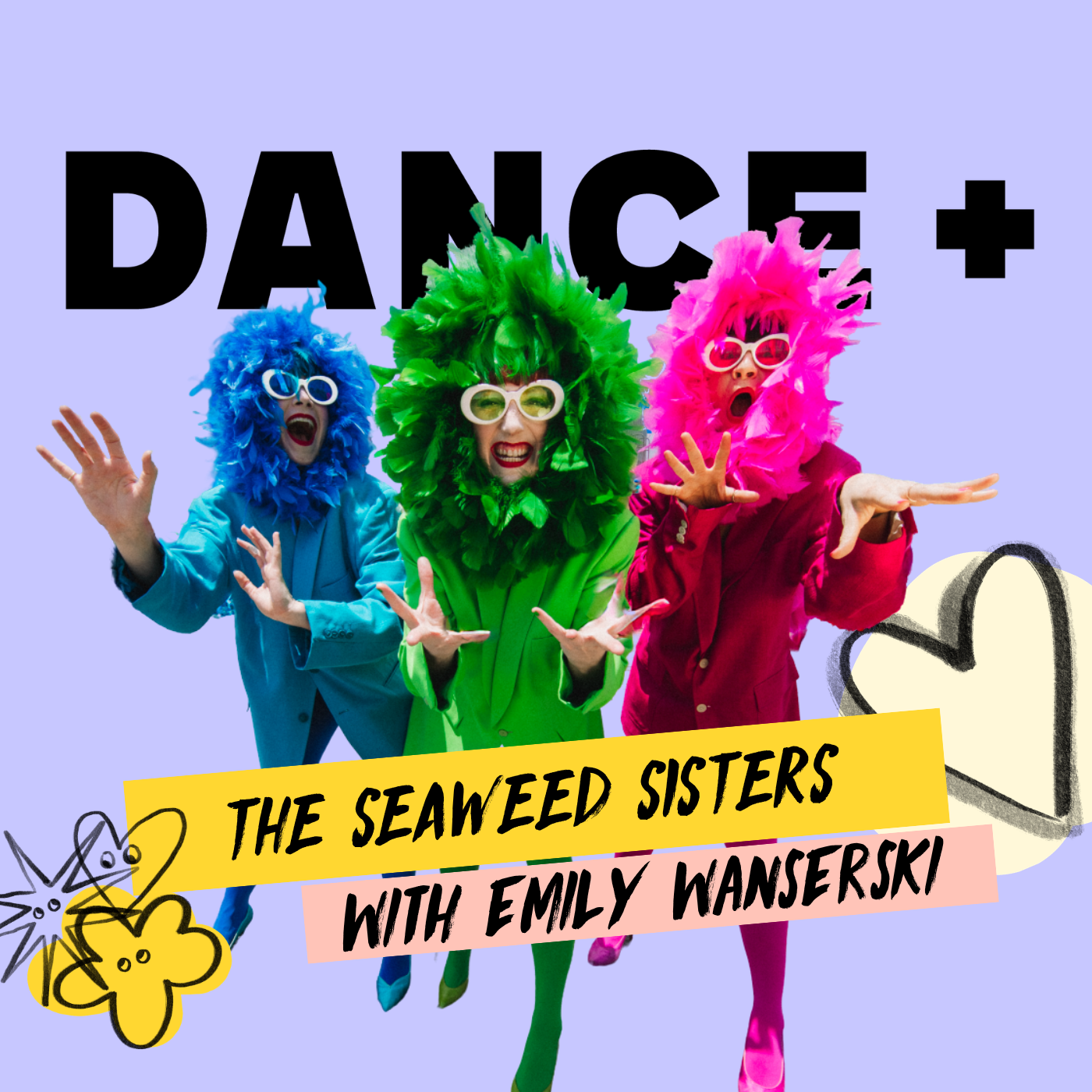
The Seaweed Sisters, myself, Jillian Myers, and Megan Lawson, had a wildly successful run of our show, We Don't Know.
Thank you, my friend.
And on our closing weekend, we had an open Q and A with our audience. That conversation brought so many important questions that I would be remiss to leave in that room.
So I've made a special episode out of that Q and A. Live from the LA Theater center with the Seaweed Sisters, Emily Wanserski, and audience members from We Don't Know. I hope you enjoy this conversation.
You see how I doubled up on the time.
English.
[00:01:10] Speaker B: Yes, you can. You can speak in English or seaweed and your answers. So we all are fluent now. So you're good to go.
I'm really honored to be here. I've been friends with these three for a while and seen the work grow. Perfect.
[00:01:28] Speaker A: You're doing great.
[00:01:29] Speaker B: So about two years ago, I started the organization with Emily and Jordan called the center for Provocative Thought. And one of our big questions is, how can we help individual artists that are not attached to a particular company or agency or client or job make the work that they want to make out of their brains? And so when we kind of started thinking of who we would try a co production with first, first, the Seawigs really kind of bubbled to the top, for so many reasons that you all now know, but also from a business perspective, thinking about how family friendly it is and how wonderful their work is for just the joy of being alive.
So I'm going to give us a little timeline of how we got here so you all understand how long it takes to get to this magical point.
So the first time we talked about, like, what are we gonna do together? Dinner was December 16, 2024.
And then we made it official with an email on March 5, 2025.
Right. So we all chewed on like, what are we doing? And then it was serious. And then in mid June, rehearsals started at our space, which we lovingly called effie house. That's student 25.
[00:02:41] Speaker C: Still.
[00:02:42] Speaker B: Our first donation came in on June 3, 2025. We opened on June 5, 2026. So it does take a year to fundraise too. And then you had a month long deep dive. December 2025, at Elements Dance Space. Thank you, Elements.
And then in February 2026, we rented the theater for two days I played, and now we're here in June.
That's when we got here. And kind of the steps. I thought that'd be helpful. And so for you all, as artists that do many things, not just the seaweed sisters, you do. You're also humans in the world, and you're friends and, you know, lovers and things, how did that timeline feel?
[00:03:30] Speaker A: We're not plucked in.
[00:03:42] Speaker D: Question. Sorry.
[00:03:45] Speaker B: How did that feel? The timeline, the process from a creative artist perspective.
[00:03:51] Speaker D: Okay, I have the mic, so I'll go for it. Pass it down. It's a gift. I think predominantly commercial work, which is. Is more often kind of the vein that we're working in. Not as seaweed, but as individuals. The timeline is always so short. So to have even that summer chunk and then walk away from something and then come back in December and have a month and then walk away is an experience that I've never had in creation.
And how it changes it, how it informs it and fuels it going forward is different.
I don't have better words to do describe the difference, but that felt like a luxury that rarely afforded in other
[00:04:31] Speaker A: things of making cosine. Also slow, fast, slow, fast, slow, fast, which we are used to in some ways. The hurry up and wait game, it kind of was that for a year. It was like, work, work, work hard, wait, wait for it.
[00:04:48] Speaker D: Think about.
[00:04:49] Speaker A: Yeah, anything goes. As most of you probably know, you never have enough time. Even with that much time, it didn't feel like enough time. We made changes. It's a day.
[00:05:02] Speaker C: We work very well on a deadline. It's what we've been doing for the last 13 years. Like, oh, we have a show next week. Perfect. Let's put a set together.
So this with time, the slow, fast, slow, fast.
We created a couple deadlines for ourselves because we know that's helpful. We did a stumble through, which I don't think you included in. Earlier in January, we were like, we're gonna invite a couple people to come and be our audience. Because it's so hard to know how things are gonna land. We know what we think is funny, but one of the most challenging parts of this is that we are inside of the work. And we are also the choreographers and
[00:05:46] Speaker B: the directors of this show.
[00:05:48] Speaker C: So we can't watch it from the outside except for a video. So the answers are a little blurrier when you're feeling it and not seeing it, wanting it to feel good and look good.
So that was so helpful to just get us to scribble through that we could show people and, yeah. And that informed so much for us that we didn't even need feedback. We were just like, all right, we have so many notes for ourselves.
[00:06:18] Speaker E: And.
[00:06:18] Speaker C: Yeah, but the time is a luxury, as Jilly said. Pure, pure bliss.
[00:06:25] Speaker B: And you said that many times with both yours. It's like we created. We got the room we created. And so, like, what does the Seaweed
[00:06:32] Speaker A: Sister rehearsal, I just watched it for 80 minutes.
It just makes me laugh. Do you think that's funny? I think that's funny. It's in. Is it funny?
[00:06:46] Speaker C: Did you laugh?
[00:06:47] Speaker B: It's in.
[00:06:49] Speaker D: A lot more English.
[00:06:50] Speaker C: A lot more English.
[00:06:51] Speaker B: What did you think of that?
[00:06:53] Speaker A: And to your question about luxury, we did talk way more during this process than in any other because of luxury of time. So maybe equal parts conversation and movement. Maybe more conversation.
So much talking round and round.
[00:07:13] Speaker D: It's a lot of navigation. We're three people that, again, outside of the work as seaweed, are individual makers and leaders. So then you have three leaders in the room. That involves a lot of creative mediation again and again and again, kind of with most every decision. So that also takes time, you know, and so making a longer work means more decisions, means much more time to mediate through them and, like, try them and then go back to the first one after trying 50 of them, you know, so.
And that's kind of. That's what process is. But I think just in general, making a longer work just meant more of those moments, more decisions. Yeah.
[00:07:50] Speaker C: And technical thought. Things that we haven't played with before. Sound, light, set, question marks. So lots of. Within rehearsal. Like, let's imagine that this can work, but we don't know if it will. Which is why our couple days in February was so helpful to be able to move forward knowing, like, okay, cloud needs to be twice the size that it was. Kelly, do you mind?
[00:08:16] Speaker E: Yeah.
[00:08:16] Speaker F: Thank you. Kelly.
[00:08:17] Speaker B: Kelly.
[00:08:29] Speaker C: Yo. Kelly built smidge freaking jello. This set, which is fully upcycled. None of this material was bought. It was all donated,
[00:08:44] Speaker A: even the rug.
[00:08:46] Speaker C: Someone had some extra lino left over from their set, and we taped it together and started taping. And was that.
I made another set. So that was really. I mean, also trying to keep it tight on the budget front, but also just we're thinking about the world and how to just have our imprint be as small as possible. So all of those things into consideration in conversation, in rehearsal.
[00:09:15] Speaker E: Yeah.
[00:09:17] Speaker B: And four people in the room. So the two days we rented the theater in February, I'm curious if we share. What did we do during Those two days, right? Most of us can imagine a dance rehearsal in a studio. We came in and what did we learn?
[00:09:32] Speaker C: Well, we got mic'd up.
Did you see our little mics?
We weren't sure if we would hang mics or just project in this theater. And then we tested it and it was nice to be able to whisper and be free to hear us. And yeah, it was just a fun thing to introduce way more language in this show. So that was a big part of our tech.
[00:10:03] Speaker A: We learned the difference between a 16 foot ladder and a 12 foot ladder. And if the 16 marks the ladder's height when it's open or closed.
We'd like to thank fire department number
[00:10:19] Speaker B: 86, Elizabeth, for donating.
[00:10:27] Speaker A: For 12 years we've been making shorties and I think we've gotten really good short films. Short ribs, shorty.
We love to curate a tiny little frame. And so we learned a lot about embiggening things and sight lines and there only being three of us and what that means for you guys when we leave.
So we learned a lot about space, sight lines, cassette rigging, lighting cameras. We have a 360 degree camera up there because this is bubble.
[00:11:07] Speaker C: So that's the bubble.
[00:11:11] Speaker A: There she is. Learned a lot about charging those.
Lots of learning.
[00:11:19] Speaker D: I think they covered it also, like going into it, I was like, emily, is this the best use of money? Because money is tight when you're self funded and we're still fundraising.
And so I really was like, yes. Also, I've never had that before, like a pre tech, basically, because normally you'd have the tech week leading into shows, that's very normal. But in that week, you always discover things that are really hard to come around at, where you're like, oh, that thing we thought was going to work like the cloud and how fast it could descend doesn't. And so now the whole thing that we built as an emotional moment is like, cut.
[00:11:57] Speaker C: Because it doesn't work.
[00:11:58] Speaker D: So that day, those two days with enough space in between to respond, the response time was also a huge gift. And I was really so thankful for you thinking of this because I, at first I was like, I don't know, what are we going to really use in those two days? But I mean, and with the cloud, it was first on a pulley system, so it was people pulling it, but you really, because of the weight of it, could kind of feel, you know, and so we were like, yeah, anything emotional is gonna be gone right then. So, you know, so then being able to order a motor and then, like, learn how long that's gonna take. Like, all of that takes so much time. So that was so, so helpful. And I highly recommend, if you ever have the chance to have a pre tech tune before your tech week to try those things. If you have tech things that you're uncertain about is really, what a gift. Yeah.
[00:12:52] Speaker A: And we also discovered, like, things that, you know, we're gonna have a big cloud, and you put a big cloud in a big space, and you're like.
And it would be great if we had a lot of little tiny clouds, too.
So we learned that our big cloud felt big in a smaller space, but it needed to get bigger by, like, two feet on both sides.
And then it pooped out little babies.
And that really helped make this three dimensional and feel like a fishbowl. Like, which is another reason why we chose this space. Because this is important, and so that is important.
And having the space available to us early informs so much of how we build the rest.
[00:13:36] Speaker B: Do we have any questions from the room?
Burning questions.
[00:13:40] Speaker D: Yes.
[00:13:40] Speaker B: Oh, my gosh.
[00:13:41] Speaker C: Hi.
[00:13:44] Speaker A: First of all, amazing show. It was amazing. Oh, it was so amazing.
I'm curious about so many things regarding the creative genesis of the show. Do you think you could explain a bit about how the characters came about? Like, inspiration for the characters?
[00:14:03] Speaker C: How long do you have?
[00:14:07] Speaker A: The characters Blue, Pink, and green were born 12 and a half years ago. Thirteen years ago, when the three of us actually. Sorry. When I was asked to choreograph a number for a show called Dancescape la, and I did not have anything to put forward at that time. And I went and took a dance class taught by Julia Meg, and they taught this number to Major Lazer. This combo was so much fun and so cool. And after class, it was like, hey, guys, what do you think about making that 2 030? And they were, like, fun. And I was like, nice. And then again, on a deadline, we put it together and made this thing. That's when you're talking Genesis. That's like, the phase one of them.
And you see that the Blue, pink and Green was born simply from the color of goggles that were available.
Yeah.
Blue eyes, so blue.
Orange hair. Green. Naturally pink, like you're born in it. It was left over,
[00:15:14] Speaker B: but I said, it's wonderful.
[00:15:19] Speaker A: And then if I. If this is the abutted version. Is that true? Is that a word? Cool.
We all are siblings. Also not together, but.
And so naturally, we take on a relational role in this creative family that we have that's sometimes the exact same as who we are in real life. And sometimes oppositesies, like por Henflo, firstborn, youngest, middle.
So that in real life, in Seaweedland, I mean, come on.
So that's how I'll, like, wrap that up. Super tiny. Also, I have a podcast.
My podcast is called Words that Move Me. I'm working on a rebrand because that's kind of a mouthful. It's not a big deal, but it's now called Dance Plus. You're the first to know.
Anyways, on a very recent episode, we dig deep into that. So instead of talking about it for
[00:16:26] Speaker D: 45 more minutes, I'll tell you.
[00:16:27] Speaker A: Go listen the episode.
[00:16:31] Speaker B: Anyone else from the room?
[00:16:36] Speaker C: Hi, everyone.
[00:16:37] Speaker E: So I know that you guys are all really talented individual creators, but everyone that has seen seaweed in any form, whether it's a shorty or it's like this, knows that there's a very distinct, like, aesthetic. And, like, seaweed is very specific. And so when you're creating, do you feel like it flows out of you? Like, that it's normal? Like, it's very natural for you to go from individual creator to seaweed, or is it something that you actually have to work towards? Like, no, this is what pink would do.
[00:17:07] Speaker B: This is what green.
[00:17:08] Speaker E: Like, this is what the seaweed sisters would do. Like,
[00:17:14] Speaker C: thank you for saying that. Because we work really hard on specificity and. And care a lot about being clear about which character is the bossy brat and which, you know, these specific sort of stereotypes. We also didn't want to be just singular colors.
We are multifaceted and have all the feelings. Not just like, oh, you're always bossy. I mean, I'm always first, but I love them. And I am sensitive too, so as a person as well as a seaweed. So we talked about this at length, and it does flow.
We go with our instinct.
That's how we kind of landed on these characters.
But forever developing, I think, because forever evolving as people and as these weeds.
Yeah, any other bounce there I might
[00:18:17] Speaker A: be bouncing around, but there aren't many containers in the entertainment industry that can house this sort of thing.
And so, like, even commercial breakdowns that I get, they're, like, wacky, silly.
If we did Oomba Lala, they'd be like, oh, oh, okay. No, what we meant was, like, awake at the camera.
And so I think all three of us have a huge appetite for play and for silly. And so most of the spaces that we work in are cool, sexy, need to sell the product, check the boxes. And so for me, when we get together like this flaws out because I'm like, oh, let me put this somewhere.
So seaweed space feels a lot like, yeah, finally I can do this thing. But there were a couple pieces in this show that were like, what is that? What are we gonna. So sometimes falls out and sometimes have to ring this bunch.
[00:19:22] Speaker D: Okay. I'm trying to think how to answer in the sense of kind of like modes. Right. You know, I don't personally feel that there's like and flip on seaweed mode, you know, but I think, you know, what actually is seaweed mode is the culmination of three.
Like when three ideas meet. Because we are similar, but we are also very different.
So I think that is actually what seaweed is, is the combination of similar but different sensibilities and the like, again, sense of play. Enjoy.
That is as opposed to individual seaweed modes. You know what I mean? Because, yeah, as both ladies have said, there's, I think, yeah, definitely traits of me and not me in my personal seaweed. So it's like, you know, that all comes in. But what seaweed is, is actually when we're. It's all mixed up, all three of us. You know, I couldn't make something seaweed alone and it wouldn't be the same because of that ping pong around.
[00:20:20] Speaker C: Yeah.
[00:20:25] Speaker B: We have our friend up here at the top.
[00:20:27] Speaker E: Okay. Hey.
[00:20:27] Speaker C: Hi. Great show.
[00:20:29] Speaker F: I.
I just. It's a two parter question.
I love the world that you created and kind of like the expectations that we got to, you know, the language, the whole thing, it was so fully developed. I personally see like a Pee Wee's Playhouse television series for you guys.
[00:20:46] Speaker E: Same.
[00:20:49] Speaker F: So part one of the question is like, what's your wish for this? And then the part two is more of a technical question. I'm curious. You mentioned all the layers between the sex, the costumes and the dancing, obviously, but the audio landscape, like, did that Light Dark song, for example, did you guys craft that? How much of the recordings were your own voices?
[00:21:13] Speaker A: So many questions after the.
[00:21:15] Speaker C: We did not sing any of the
[00:21:17] Speaker F: songs,
[00:21:20] Speaker C: but some of our dear friends did sing some of these songs.
Joe Barry.
Joe is a dear friend, an incredible musician and artist and we've worked with him before. He created the music for our film Rax and also our more recent film Still Got It.
This is all his voice, his tunes, and we asked him to make a few tracks for this show, including Sunshine, Friendship, Dance.
And he is the voice of Petit.
That's.
[00:22:22] Speaker A: That's Joe.
[00:22:23] Speaker B: I know.
[00:22:25] Speaker C: And we also, for our Flolos I remember being like, oh, Jilly, it ain't easy. Being green would be so cute. And she was like, it would be. But also, I'm gonna ask Dre to sing it.
A friend of ours, she goes by Steady Holiday.
And similarly, I had a friend cover Aerosmith's Pink and Pony Club. His name is Michael Bernard Fitzgerald, Calgary artist where we went to high school together.
He made my Flolo and then a lot of just good jams. We got Dindana in there. Oomba la La, Super Bad Sisters.
These were all. Yeah, we wanted to go on a ride. And Light Dark Light by Fred again, I had a dance to this song because I really love this artist. And then when we were talking about the idea of cloud in this moment of conflict and dark, heavy feelings, I was like, I got the song.
That's all.
That's it.
[00:23:30] Speaker A: To the part of your question where you ask, what is next?
We would love to take this show on the road.
Coming to elementary schools. Do you.
Can you see it?
Conveniently, all this breaks down quite flat.
It's small show that gets big. It's a clown car.
And thank you guys for helping us be one step closer to doing that.
I also would love a Pee Wee's Playhouse, Sesame street type of situation where we work really hard for five days, and then it goes out and makes money for many, many years.
That's awesome.
But after so many years of making films, it really does feel fun to flex this live muscle. So show on the road is in the works. Question mark. Tell your friends.
[00:24:36] Speaker D: Did we answer all of it? I think so.
[00:24:39] Speaker C: Yeah.
[00:24:42] Speaker B: I'll take one more from the crowd.
[00:24:45] Speaker C: Yeah, I just.
[00:24:47] Speaker B: Two more.
Two more.
[00:24:50] Speaker A: I really like this show. Can you kind of, like, explain, like, the storyline of, like, the performance?
[00:24:56] Speaker F: Yes.
[00:24:57] Speaker A: Okay.
[00:24:59] Speaker D: I'm like, yeah.
[00:25:00] Speaker C: Can I? Can I?
[00:25:02] Speaker E: Okay.
[00:25:03] Speaker D: So we very consciously didn't write it as a story, like beginning, middle, end. We did that on purpose because we wanted to be able to have sections of the show that maybe we could rearrange or take some out or do them on their own.
[00:25:20] Speaker A: So.
[00:25:21] Speaker D: But the kind of driving thought or feeling that we wanted all of the sections to be in response to.
Have you ever invited someone to your room? You're like, hey, do you want to come see this thing in my room?
That's it. That's what we wanted the whole thing to feel like. So, you know, like, we want to
[00:25:40] Speaker A: show you you our dance.
[00:25:41] Speaker D: We want to show you our pet. Did you see this smidge? You know, we're going to try this on. Oh, I want to play this game. We don't know the rules, but we're making it up right now. You know, that's. That's kind of the inspiration point. So it's a loose journey, but maybe not a story.
[00:25:57] Speaker B: Yeah,
[00:26:06] Speaker A: Sing it. You have to sing it,
[00:26:11] Speaker C: Like, for real.
[00:26:12] Speaker B: Okay,
[00:26:18] Speaker A: You're fine, you're fine.
What was the language?
Yes, great question. How did you create the language that
[00:26:32] Speaker E: you guys speak in it?
That was, like, all I was thinking
[00:26:37] Speaker B: about the whole time.
[00:26:40] Speaker A: Shame about that dancing, huh?
I don't know when we decided you hit. You found the sweet spot in this mic. It's like over here. There it is, There it is.
I don't remember when we decided that we don't speak English because in our first show, it was only a dance. Oh, must have been when we started doing live things.
And we love engaging with people, but we love even more than people the idea of otherness and being different, but very relatable.
So I think the idea to not speak English was born from that idea.
And at the beginning it was much more gibberish.
But to sustain an 80 minute show and have you guys feel like you're
[00:27:29] Speaker B: inclusive,
[00:27:31] Speaker A: it became what we're calling now Swinglish, which kind of flubs and kind of blubs and kind of shhs and kind of fluffs. And it was still in development and we encourage you all to try.
[00:27:47] Speaker B: Yeah.
[00:27:48] Speaker A: Duolingo coming soon.
[00:27:55] Speaker C: Make a flictionary.
[00:27:58] Speaker A: Working on it.
[00:27:59] Speaker B: All right, well, I. That is all our time.
And we have two shows tomorrow, so we're going to sneak out the back, go to bed. And you should too.
Make your way out safely, though. And again, thank you for coming.
[00:28:30] Speaker A: Dance plus is produced by me with the help of many big, big, big, big. Love to our executive assistant and editor, Riley Higgins. Music is by Max Winnie. Logo and brand design by Bri Reitz. Our communications team consists of Ori Vajadares and Sydney Richardson. And we've got extra help from LMU intern Carly Clayton. If you're digging the podcast, please leave a review or rating. Also, if you want to connect with me and the many marvelous members of the Words that Move Me community, visit danceplus podcast.com if you're curious to know more about me and all the stuff I do outside of the podcast, visit thedanawilson.com.